
Nearly every day we are confronted with another national situation that fuels polarity. Most recently, it’s the sexual misconduct allegations against Roy Moore, the conservative Republican judge in Alabama who is running in a tight race for US Senate. Even tragedies, like the massacre in Las Vegas, which would typically unite even the most antagonistic, have incited hateful words like verbal bombs tossed across the political fence in the middle of what is already a bloody battle. Opposing views are shouted down and drowned out today on college campuses, where the freedom of speech has historically been vehemently defended.
However, in pockets across the country, there are groups of people who are kicking against the goads of mainstream media and deciding to do it differently. My liberal, Seattlite friend, Kellie Newton, and I started our Heart Perception Project nearly one year ago, and continue to encourage and train others to have civil conversations like the one we taped yesterday morning regarding the Roy Moore dilemma. I’ve posted it below.
Other groups, like Q Ideas and the Ohio Civility Project are doing similar work. And, in my little town in Colorado, two polar opposite men initiated a “Meeting of the Minds” for any members of our community who would like to meet every two weeks in a private room at a local coffee shop to discuss “worldview.” We touch on a variety of political issues; this past week abortion was a focus. 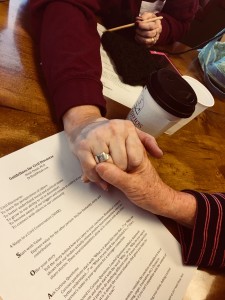 One woman was pro-choice because she had gotten pregnant at 39 and was glad she had the choice to have a child- or not (she chose to have him). The woman across the table from her was an abortion survivor and was pro-life. It took effort and empathy for the two of them to really listen to each other and seek to understand. And, in the end, the abortion survivor reached across the table to grasp the hand of the other woman. They had connected despite the polarity of their deeply held beliefs. This, my friends, is how we bridge the great divide in America.
I encourage you (yes, you) to host a dinner with diverse people, initiate a meeting at a local coffee shop, or just have a conversation with a friend who sees the world from a different view than you. Let’s learn how to connect with each other even when we disagree. Because our families, our neighborhoods, our communities, and our nation are worth it.
At our last “Meeting of the Minds,” I shared my handout, “Guidelines for Civil Discourse,” including the 4 Steps to a Civil Conversation which I’m posting here for you to use as well. It’s part of my larger work on communication called, “Speak Eagle,” in which we learn to interact from a place of trust instead of a place of fear and find the courage to SOAR through difficult conversations. More on that in a future post…
Guidelines for Civil Discourse
Heidi Petak, Ph.D.
Goals of Civil Discourse:
To learn the perspectives of others
To better understand social and political issues
To grow in our ability to sit in discomfort
To become aware of our triggers and remain in control of our responses
To connect with others in our community
4 Steps to a Civil Conversation (SOAR):
S- Start with Value
Express value for the other- his/her humanity, story, and contribution
O- Offer your story
Tell the story behind how you came to your conclusion. Biomedical research shows that our bodies actually release positive neurotransmitters when we share stories. These neurotransmitters allow us to connect with each other.
If you want to share facts and the logical reasoning that has informed your values or beliefs, share them within the context of story. Where you first read the information or who shared the information with you, how that information affected you and what you chose to do about it afterwards.
A- Ask Curious Questions
Curious questions start with “What is it about this issue that…?” or “Help me better understand…?” or “What do you think has contributed to…?” Use a person’s name in your question for a stronger connection.
As opposed to Curious Questions, Loaded Questions embed a statement and often start with the word “Why,” as in, “Why do you expect your party to do anything different now?” A more curious question would be, “What is it about the current situation that gives you hope for things to be different now?”
R- Respond with Empathy
When a person answers a question, consider the emotion embedded in his or her answer (i.e. fear, hope, longing, anger, frustration, etc.). Choose to empathize with that emotion, even if you can’t empathize with the content of the person’s response.
Repeat steps in any order during your conversation, again asking curious questions, responding with empathy, telling your story, and communicating value.
Now, watch Kellie Newton and I have a civil conversation as we hash out The Roy Moore Dilemma…